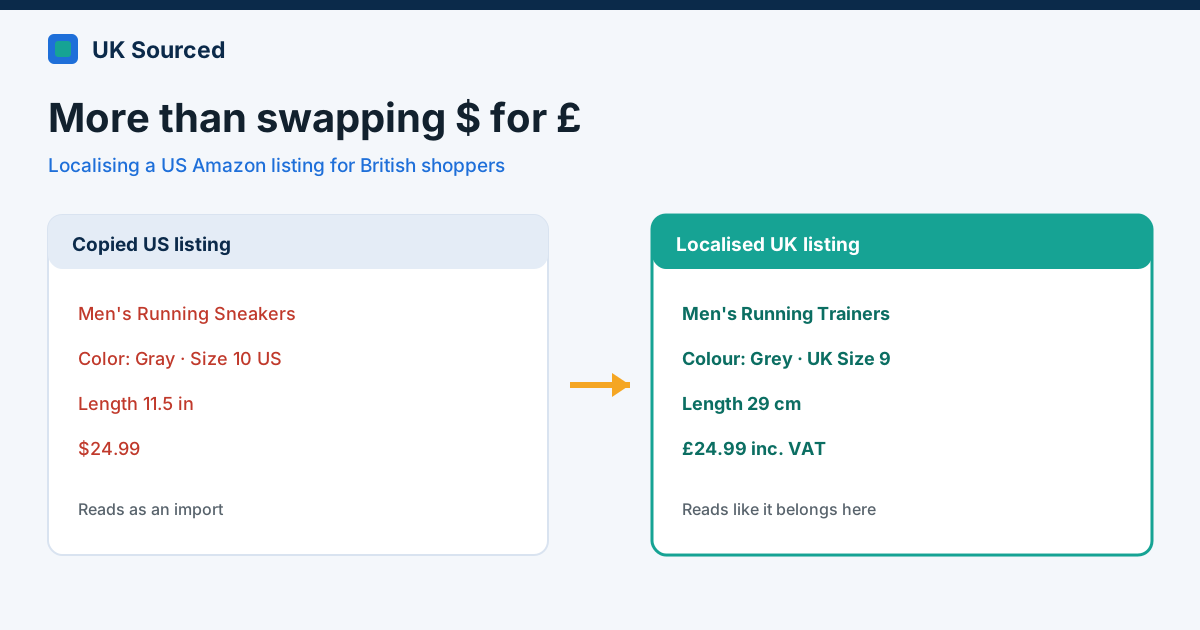
Localising a US Amazon listing for UK shoppers: more than swapping $ for £
Copying your US Amazon listing to the UK costs sales. Here's how to localise it properly: vocabulary, spelling, sizes, VAT-inclusive pricing, images and keywords.
Here's a test we run on most US brands' UK listings. Search Amazon.co.uk for the product the way a British shopper would. Then search the way an American would. More often than you'd expect, the brand only turns up for the American search.
That's what a copied-across listing costs you. It's written in a language that's almost the same as the one your customers speak — and "almost" is where the sales leak out.
Same words, different meanings
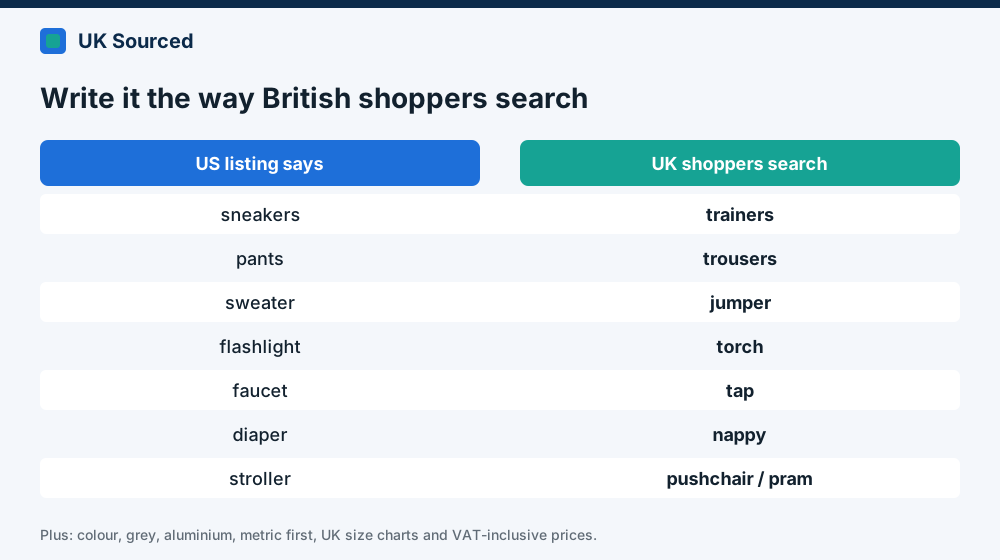
British and American English share most of their vocabulary. The bits they don't share happen to include plenty of product names, and those are exactly the words people type into a search bar.
A few we see constantly:
- sneakers → trainers
- pants → trousers (in the UK, "pants" means underwear — a mistake worth avoiding)
- sweater → jumper
- flashlight → torch
- faucet → tap
- diaper → nappy
- stroller → pushchair or pram
- cookie → biscuit
- zipper → zip
- garbage can → bin
If your title says "sneakers", Amazon's search will often still find you for "trainers". But your listing reads as foreign, and foreign reads as "imported, slow, maybe not for me". Write it the way the customer says it.
Spelling and units
Next comes the smaller stuff that adds up. British spelling uses colour, grey, aluminium, centre and organise. Measurements should lead with metric — centimetres, litres, kilograms — even if you keep inches in brackets. A listing full of "color" and "6.5 in" looks like it was written somewhere else, because it was.
Sizes don't match
If you sell clothing or footwear, this one is critical. UK and US clothing and shoe sizes use different scales. A US women's dress size and the same number in the UK are not the same garment. Neither are the shoe sizes. Give a clear UK size chart, and put it in the images as well as the text. A wrong size is the fastest route to a return, and a return across a border is expensive.
Price like a British shopper
UK shoppers see prices that include VAT. American shoppers see prices before sales tax. So a $24.99 price doesn't simply convert to a sensible pound figure. Work out your UK price from landed cost plus VAT, then land on a price point that looks normal to a British shopper, such as £19.99 or £24.99.
Check your images
Images travel worse than text, because nobody thinks to check them. Look for:
- Plugs and sockets — a US plug in a lifestyle shot of an electrical product is a red flag to UK buyers.
- Dollar signs, US-only claims or US measurements baked into infographics.
- Size charts in US sizes only.
Do the keyword research again
Don't translate your US keyword list. Research the UK from scratch. British shoppers use different terms and different phrasing, and search volumes differ even for the same words. Your UK backend search terms deserve their own list.
Reviews start a new life
Some international reviews can show on a UK listing, but in practice your UK presence builds its own review history. Plan for that. Amazon Vine, a tight launch and patience all matter as much in the UK as they did when you launched in the US.
Why it's worth the effort
Localisation is one of the cheapest growth levers you'll ever pull. It costs some writing time and a few image edits, and it lifts both how often you're found and how often you're bought. It's also the part of a UK launch that brands most often skip, because the listing "already exists".
Getting the UK setup basics right matters too. But a perfectly compliant listing that reads American will always underperform one that reads British.
We're British, we write British listings every day, and we do keyword research on Amazon.co.uk for overseas brands. If you'd like us to look over your UK listings, drop us a line at enquiries@uksourcedltd.com.