The British products that are hard to sell in America (and the ones that travel well)
Some UK products sail onto Amazon.com; others hit US rules on food, wood, metal, batteries or children's goods. Here's how we screen British products for the US.
"Americans love British stuff." It's true, and it's the reason so many UK brands look across the Atlantic. But loving a product and being allowed to buy it easily are two different things.
Since the US scrapped its de minimis exemption, every shipment goes through proper customs entry, and that has put US product rules front and centre. When we screened British product categories for Amazon.com this year, the list of things that need extra work turned out to be long. Some of it was genuinely surprising.
Here's the short version. It's a practical guide, not legal advice. Every product deserves its own check with a US customs broker before you ship.
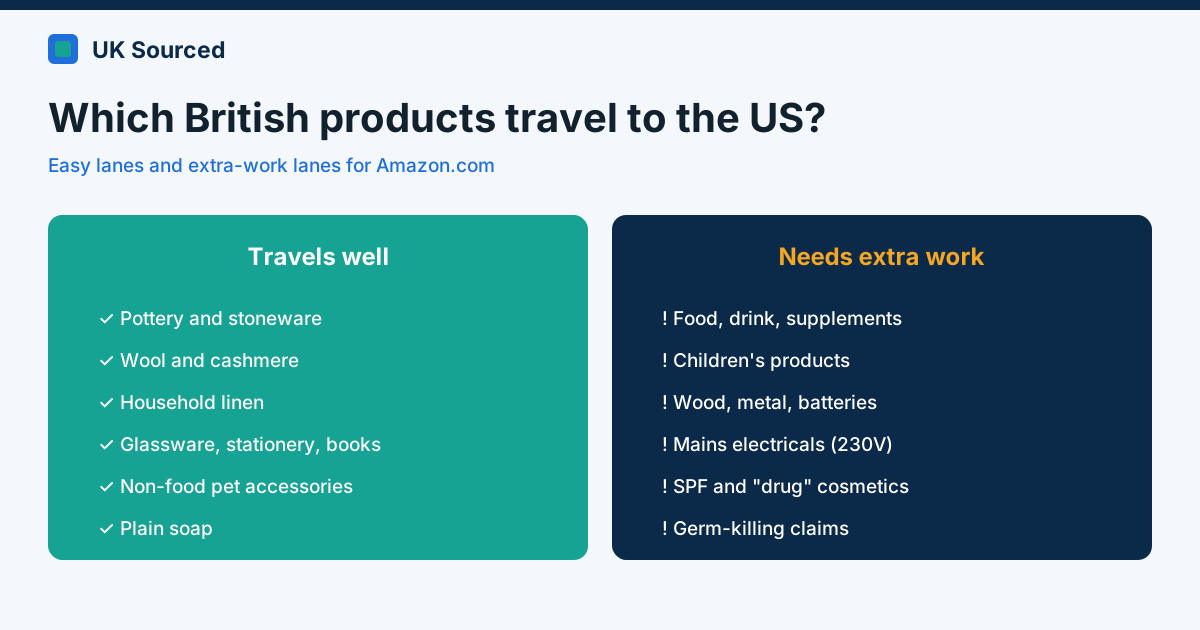
The products that need real work
None of these are impossible. Big brands sell all of them in America. But each one adds paperwork, testing or registration that a first shipment often isn't ready for.
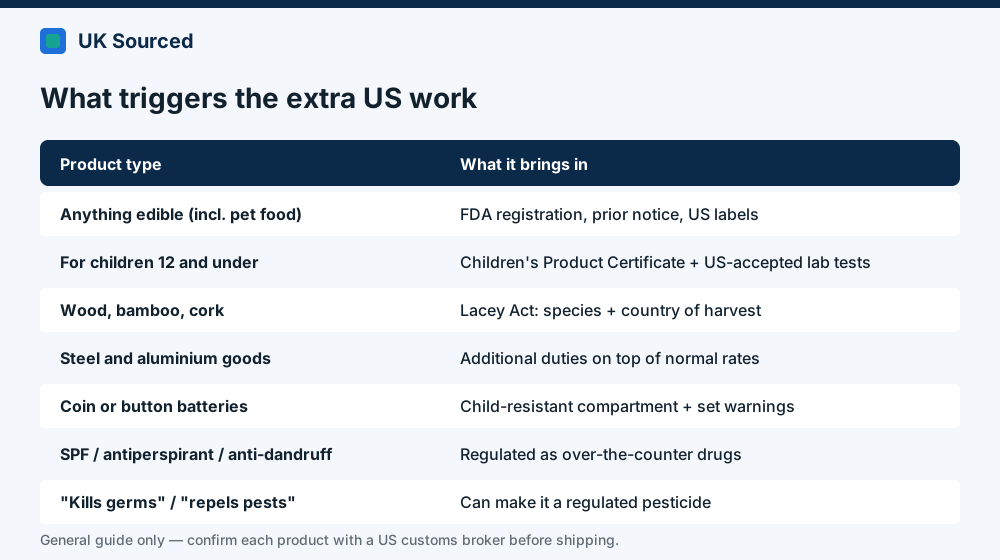
Food, drink and supplements. Anything edible — for people or pets — brings in the US Food and Drug Administration: facility registration, advance notice of each shipment and US-format nutrition and allergen labelling. A UK pack won't have those. Watch out for "gift sets", too: a tin is just a tin, but a tin with biscuits in it is a food import.
Children's products. Anything designed for children aged 12 and under needs a Children's Product Certificate, backed by testing at a US-accepted laboratory. UK toy testing doesn't automatically carry over.
Wood, bamboo, cork and similar materials. Under the Lacey Act, plant-based materials need declaring with their species and country of harvest. If you don't know exactly what wood a handle is made from, you can't declare it properly.
Metal goods. Many steel and aluminium products face additional US duties on top of normal rates. Run the numbers before you assume a metal product is still profitable once it's landed.
Anything with a battery, especially coin or button cells. US rules require child-resistant battery compartments and specific warnings, on the product and its packaging.
Mains electricals. UK appliances are built for 230V and UK plugs. America runs on 120V. Even simple digital gadgets can carry US certification duties that land on the importer.
Cosmetics with "drug" claims. In the UK an SPF moisturiser is a cosmetic. In the US, sunscreen is regulated as an over-the-counter drug — and so are antiperspirants, anti-dandruff products and similar items. Rewording the listing won't fix it.
Anything that claims to kill germs or repel pests. In the US, the claim itself can turn an ordinary product into a regulated pesticide. That includes a claim printed on the box.
The products that travel well
On the other side of the ledger, plenty of British strengths sit in quieter, simpler categories:
- Pottery and stoneware — teapots, mugs, jugs and bowls. British ceramics have a loyal American following.
- Wool and cashmere accessories — scarves, wraps, gloves and hats.
- Household linen — tea towels, aprons, table linen and throws.
- Glassware and non-metal kitchen tools.
- Books, stationery and paper goods.
- Non-food pet accessories — bowls, leads, collars and beds.
- Plain soap, sold and labelled simply as soap, with no medical claims.
What these have in common is low regulatory friction. They don't need registrations, approvals or US-specific testing, so they're a sensible place to start a US channel and learn the logistics.
A few rules that apply to everything
Whatever you sell, three things catch out UK shipments:
- Country of origin marking. Every item must be clearly marked in English with where it was made, and the marking has to survive Amazon's prep.
- Pallets. Wooden pallets and crates must be heat-treated and stamped to the ISPM 15 standard, or the shipment can be refused at your expense. Specify it with your forwarder rather than hoping.
- Brand restrictions on Amazon. Some brands control who can sell them on Amazon.com. If you're not the brand owner, check before you buy the stock, not after.
Our view
The mistake we see most is choosing the product first and checking the rules second. Turn it round. Start with the categories that travel cleanly, prove the freight and the FBA process with them, and add the harder categories once you've got the setup to handle them.
We screen products this way before anything ships, for our own trading and for the brands we work with. If you'd like a second opinion on whether your range is US-ready, drop us a line at enquiries@uksourcedltd.com.