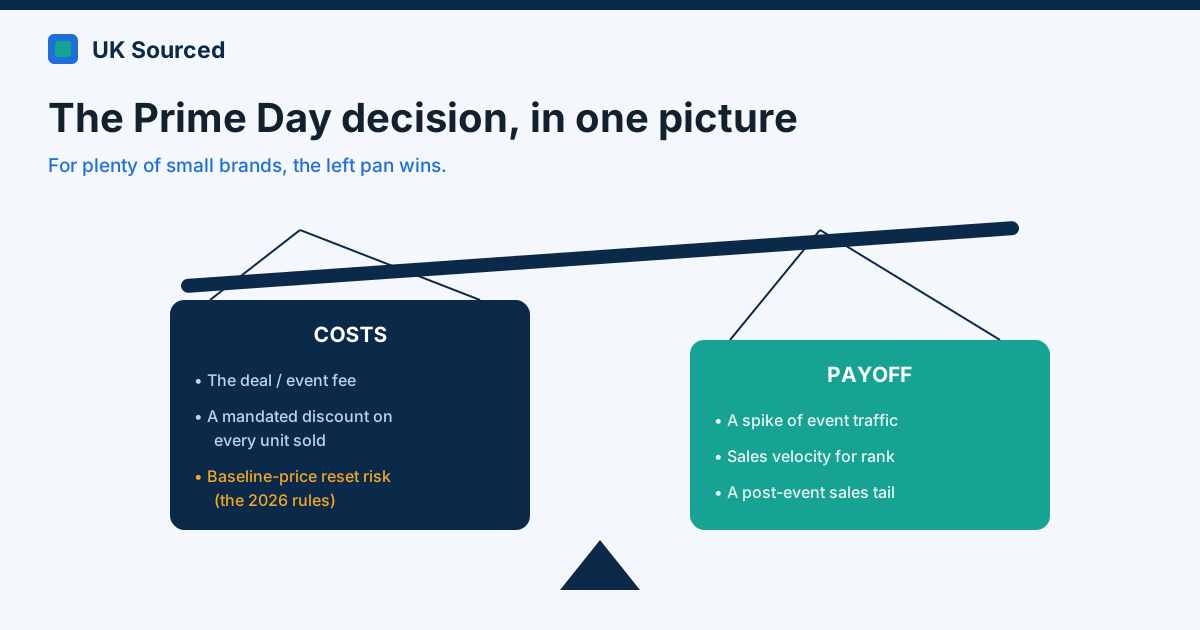
Is Prime Day actually worth it for small brands?
Is Prime Day worth it for small brands? The honest maths on deal fees, margin and the traffic halo — plus the 2026 pricing trap that can reset your price.
Prime Day happens whether you join in or not. Your category fills up with strike-through prices, your competitors spend silly money on deal placements, and shoppers turn up in numbers you won't see again until Black Friday. So the question isn't whether Prime Day is big. It obviously is. The question is whether a small brand actually makes money from it — and more often than anyone admits, the honest answer is no.
We've run Prime Day pushes that paid for themselves several times over. We've also told clients to sit the whole thing out, and been right. The difference was never enthusiasm. It was maths. Here's the sum we run before every event, so you can run it on your own numbers.
What a Prime Day deal really costs
There are three costs, and most sellers only count the first.
The discount itself. To get proper deal placement in 2026, Amazon expects a real discount — the token few percent that used to earn a badge doesn't qualify any more. Say you sell at £24.99 and clear £6 a unit after your product cost, fulfilment and Amazon's referral fee. A 20% event discount takes £5 off the price, and nearly all of it comes straight out of your £6, because the referral fee shrinks a little but your product and postage costs don't move at all. You're now clearing pennies. To match an ordinary day's profit you don't need a good day; you need several times your usual volume. Those are illustrative numbers, but the shape holds on almost every account we've looked at.
The deal fee. Lightning Deals and Best Deals carry a flat charge just to run, and it's higher during event weeks than at any other time of year. Not enormous on its own. But when your per-unit profit has dropped to pennies, that fee is another pile of units you have to shift before the event has broken even at all.
The baseline risk. The third cost is the quiet one, and it deserves its own section.
The 2026 trap: a deep deal can reset your price for good
Amazon's 2026 pricing rules watch a rolling 90-day window. Sell below your standard price for more than half of it and Amazon resets your baseline downward — your strike-through price shrinks or vanishes, and every future discount gets measured against the new, lower number. Undoing it is slow, awkward work.
A single two-day Prime Day deal won't trip that on its own. But event discounts rarely travel alone. A warm-up coupon in June. The deal itself. A "keep the momentum going" promotion the week after. A forgotten 5% clip still live from spring. Count the below-baseline days across all of that and you can drift past the threshold without ever deciding to — at which point your £24.99 product becomes, in Amazon's eyes, a £19.99 one. Permanently, or near enough. We've broken down exactly how the rule works in Amazon's 2026 pricing rules; if you're planning any event discount this year, read that first and count your days before you commit.
The halo is real — but look at the whole month
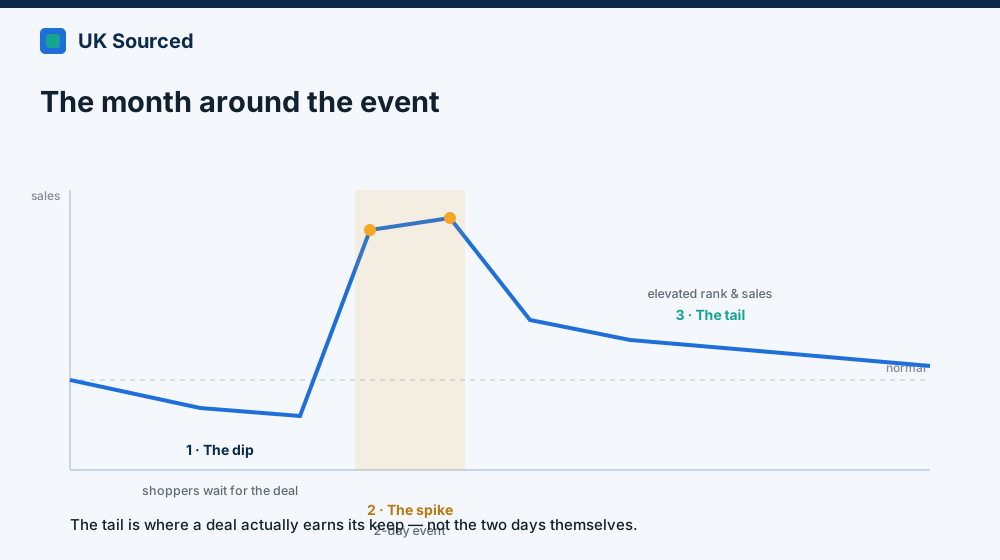 The month around the event: a dip, a spike, then the tail — which is where a deal actually earns its keep.
The case for Prime Day was never really the event itself. It's what happens around it.
In the week or two before, sales often sag, because shoppers park products in baskets and wait for the deals. During the event, traffic surges across the whole site — including onto listings that aren't discounted at all. And afterwards comes the part that matters: a heavy burst of sales feeds the ranking algorithm, which can hold your product higher in search results for weeks. That tail is the real prize. You take the margin hit for two days and collect better organic position for a month.
The halo cuts both ways, though. If the event drains your stock and you run out the week after, the algorithm reads it as your sales falling off a cliff, and the rank you just paid for evaporates. Going into Prime Day with three weeks of cover is worse than not going in at all — honestly, shallow stock is the single most common reason we tell a brand to sit out.
Deal, coupon, or nothing?
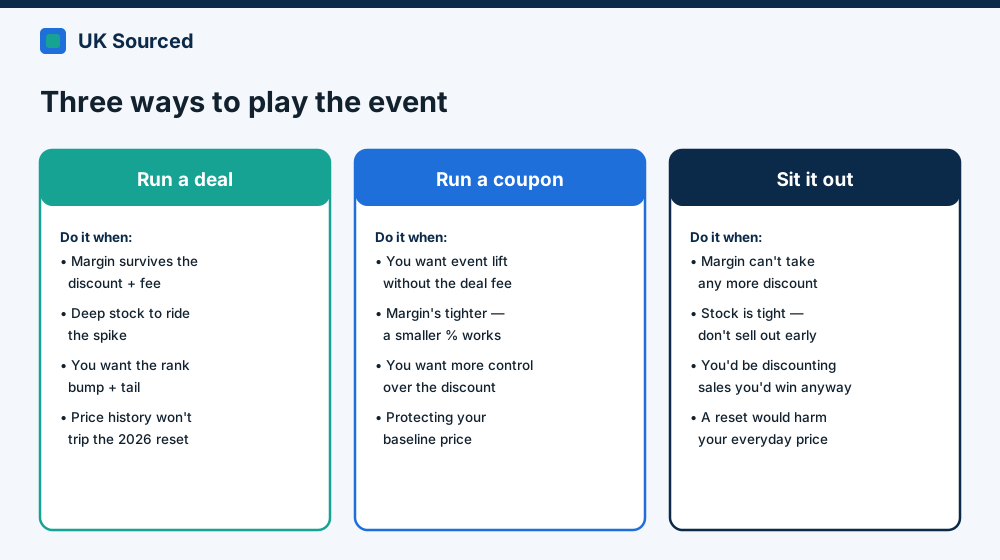 Three ways to play the event. Pick the one your margin, stock and pricing window can actually afford.
Run a deal when the maths survives all the way down. That means margin that can absorb the discount and the fee and still leave something behind. Stock deep enough to sell hard through the event and keep weeks of cover afterwards. A clean 90-day window. And ideally a reason beyond "it's Prime Day" — a launch you're pushing, a ranking fight you're close to winning, a product where velocity matters more than this month's profit. If you'd tolerate a high launch ACOS, the same logic can justify a lean Prime Day.
Run a coupon when you want visibility without the commitment. A coupon badge shows on your listing in search results during the busiest shopping days of the summer. The discount can be modest. There's no big flat fee, just a small charge per redemption, and you stay in control — the moment stock or margin says stop, you switch it off. For most small brands this is our default answer: most of the benefit, a fraction of the exposure. Kept short, it also spends far fewer of your below-baseline days.
Sit it out when the numbers say so. Thin margin, shallow stock, or a listing that isn't converting well yet. Prime Day multiplies traffic, not conversion — a product that converts poorly at full price converts poorly at 20% off too, just with less margin left over. And sitting out isn't doing nothing. Shoppers are already on the site in huge numbers, and full-price sales happen all through the event. One brand we manage did perfectly respectable Prime Day numbers at full price, largely because a discounted rival sold dry by lunchtime on day one. (Amazon doesn't send you a thank-you card for joining in, whatever the deal dashboard implies.)
Our honest take
Prime Day is a tool, not an obligation. For a small brand with genuine margin, deep stock and a clean pricing window, a well-planned deal is one of the better rank investments going. For everyone else — and that's most small brands, most years — a short coupon, or a full-price listing with slightly braver ad bids, keeps you in the game without donating your margin to the event.
If you'd rather someone ran this maths on your actual numbers — your margin, your stock cover, your 90-day window — before the next event, that's a normal week's work for us. Drop a line to enquiries@uksourcedltd.com and we'll tell you straight whether your Prime Day is worth joining.