Your US brand is on Amazon UK — but is it really selling there?
Many US brands appear on Amazon.co.uk only through Amazon Global Store. Here's how to spot it, what it quietly costs you, and how to build a real UK channel.
"We've been selling in the UK for a couple of years now." We hear this a lot from overseas brands, and it's usually said with some pride. Then we open Amazon.co.uk, find their listings, and look at who the seller is.
It isn't them. It's "Amazon US".
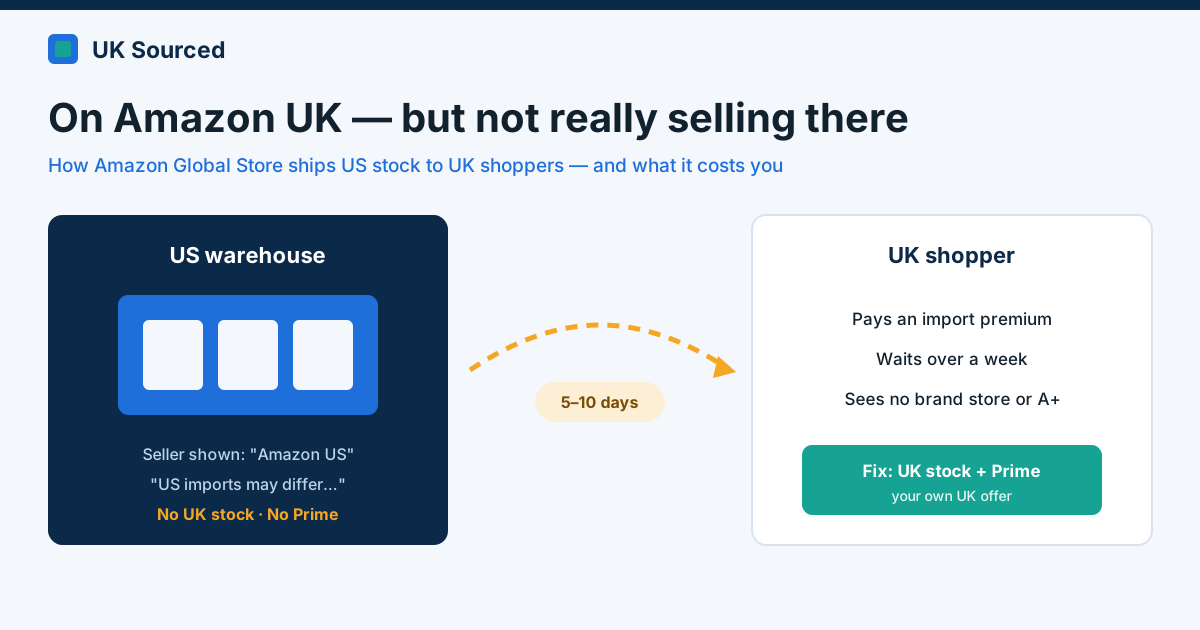
That small line of text changes everything. It means the brand doesn't have a UK operation at all. Amazon is taking stock that sits in American warehouses and offering it to British shoppers through Amazon Global Store. The listing looks live. Sales trickle in. But the brand is a passenger, not the driver.
How to tell if you're in Global Store
You don't need Seller Central access to check. Open one of your listings on Amazon.co.uk in a private browser window and look at three things:
- Who sells it. If the buy box says the item is sold by "Amazon US" rather than you, a UK distributor or Amazon UK, it's coming from US inventory.
- The small print. Global Store listings carry a notice along the lines of "US imports may differ from local products. Additional terms apply."
- The delivery date. Expect 5–10 days rather than next day, and no Prime badge.
When we audited an overseas garden brand earlier this year, every one of its UK listings — more than a dozen — matched all three. Plenty of listings, zero UK stock.
What it quietly costs you
On paper, Global Store looks like free UK exposure. In practice it's a ceiling, and it's lower than most brands realise.
The shopper pays for the border. In that audit, the brand's flagship kit sold on Amazon.co.uk for close to £28. The same product was listed on the brand's own website from around $23 — roughly £17 at the exchange rate that week. Treat that gap as indicative, because "from" prices cover several variants, but the direction is clear. British shoppers were paying a hefty premium for an import, and the brand had no say in it.
No Prime, so fewer sales. UK shoppers are used to next-day delivery. A 5–10 day delivery promise next to a Prime-badged competitor is a hard sell, and you'll never see the shoppers who scrolled past.
None of the growth tools. In our audit, none of the UK-side tools were available on those listings: no Sponsored Products ads, no Brand Store, no UK A+ Content, no Subscribe & Save. That's most of the levers you'd normally pull to grow a channel.
No control over price. You can't run a promotion, react to a competitor or protect your positioning. Amazon US sets the price.
Honestly, the most frustrating part is that these brands often do have UK demand. The reviews prove it. They're just serving it through the most expensive, least controllable route available.
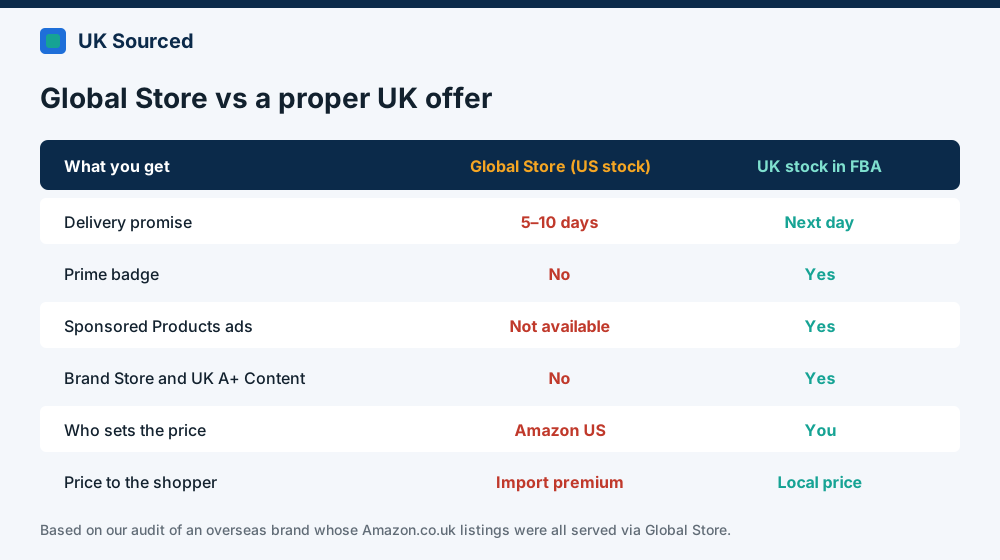
Global Store is a shop window, not a business
We'd put it bluntly: Global Store is fine as a free test of whether British shoppers want your product. If you've got steady reviews coming in from the UK, the test has already given its answer. Leaving it there means leaving the margin, the conversion and the brand-building on the table.
The fix is to get stock into the UK and sell it yourself — or through a partner who does it for you:
- UK stock in Amazon's UK fulfilment centres. That brings the Prime badge and next-day delivery, which on its own lifts conversion.
- A UK seller account on Amazon's European marketplace. It's separate from your US account and needs its own setup.
- The UK paperwork. An EORI number to import, UK VAT registration (overseas sellers holding UK stock generally can't rely on the £90,000 threshold) and product compliance checks. We'll cover these in a dedicated checklist.
- A UK-priced offer. Once you're landed locally, you can usually undercut the Global Store price and earn more per unit, because the import premium no longer exists.
A proper UK offer with Prime will generally out-compete a cross-border one for the Buy Box, because Amazon weighs delivery speed and landed price heavily. So the Global Store listing doesn't block you. You simply overtake it.
Where to start
Check your listings this week. If "Amazon US" is the seller, pull together three numbers: your UK review count, your current UK price and your landed cost if you shipped a pallet over. Those three usually tell you whether a real UK channel is worth it. More often than not, it is.
We're a UK-based Amazon agency, and helping overseas brands move from Global Store limbo to a proper UK operation is a big part of what we do — the stock, the paperwork and the listings. If you'd like us to run the numbers on your brand, drop us a line at enquiries@uksourcedltd.com.