How do I get more reviews on Amazon (without getting banned)?
How to get more reviews on Amazon without risking your account — the Request a Review button, legal inserts, Vine, and the shortcuts that get sellers suspended.
A hundred orders. Three reviews. That's not bad luck — that's roughly the deal on Amazon.
Most buyers take the product, use it perfectly happily, and never say a word. The ones who do speak up unprompted are disproportionately the annoyed ones. So your listing crawls towards double figures while a competitor sits on 900 reviews and hoovers up every click, and somewhere around week six a thought creeps in: everyone else must be gaming this. Maybe I should too.
Don't. Not because we're precious about rules — because Amazon treats review manipulation as a capital offence, and the punishment lands on your account, not just the listing. Here's what's actually allowed, and why the shortcuts cost far more than they ever pay back.
First, know where the line is
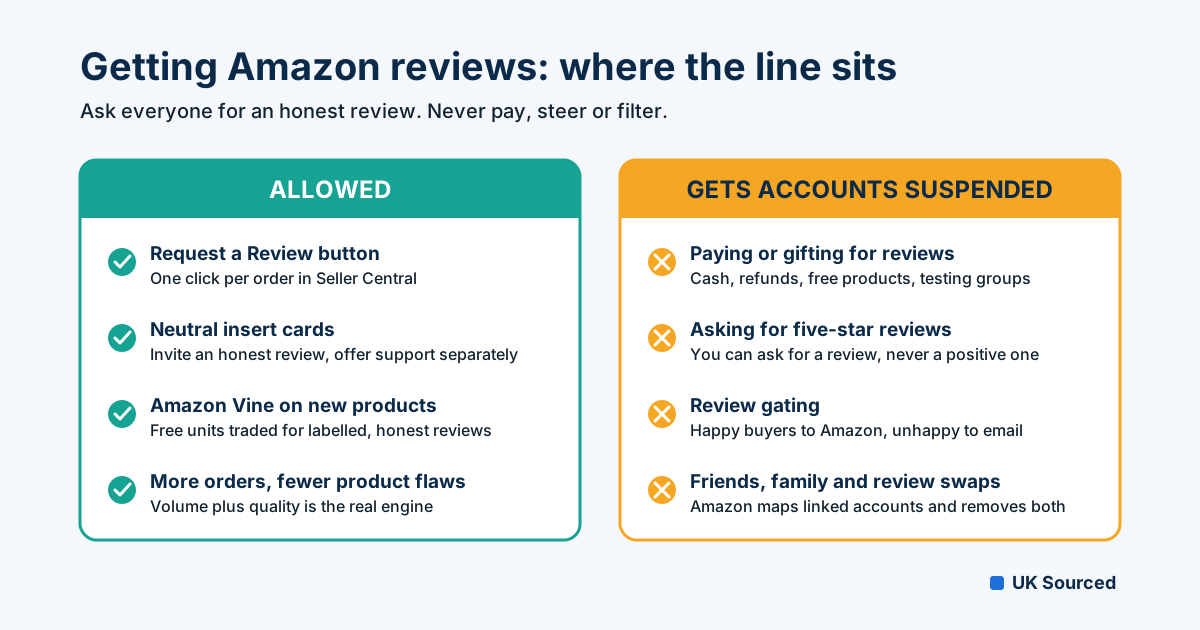
Amazon's position is blunt: a review must be the customer's honest, uninfluenced opinion. Anything that pays for it, trades for it or steers it counts as manipulation. In practice that bans:
- Paying for reviews. Cash, gift cards, refunds after purchase, "product testing groups" on Facebook or Telegram. All of it.
- Free or discounted items in exchange for a review. The exchange is the offence, not the discount.
- Review swaps with other sellers, and reviews from friends, family or staff. Amazon maps relationships between accounts better than you'd believe.
- Review gating — nudging happy customers towards Amazon while diverting unhappy ones to a quiet feedback form. Feels harmless. Explicitly banned.
- Asking for a positive review. This one catches decent, well-meaning sellers constantly. You may ask for a review. The moment you specify which kind — five stars, positive, glowing — you've crossed the line.
Penalties escalate from deleted reviews to suppressed listings to full account suspension, and a manipulation flag is one of the hardest suspensions to argue your way back from. We've written about what that process involves — you do not want that week.
Notice what isn't on the banned list, though: asking. You're free to ask every single buyer for an honest review. Most sellers either do it badly or don't do it at all.
The Request a Review button — boring, legal, effective
Open any order in Seller Central and you'll find a button labelled Request a Review. Click it and Amazon emails the buyer — Amazon's own template, in the buyer's own language — asking them to rate the product and the seller. It becomes available once the order's delivered and stays live for a window of a few weeks afterwards.
You can't edit the message. That's the point. Because the wording belongs to Amazon, it's impossible to break a rule with it, which makes it the one follow-up you can run on autopilot with a clear conscience. Approved tools will press the button for every eligible order automatically, and if you're doing any volume, you should let one. Going from asking nobody to asking everybody is the cheapest improvement available to you.
(It's also delightfully hard to mess up — which, for a compliance-sensitive job, is a feature rather than an insult.)
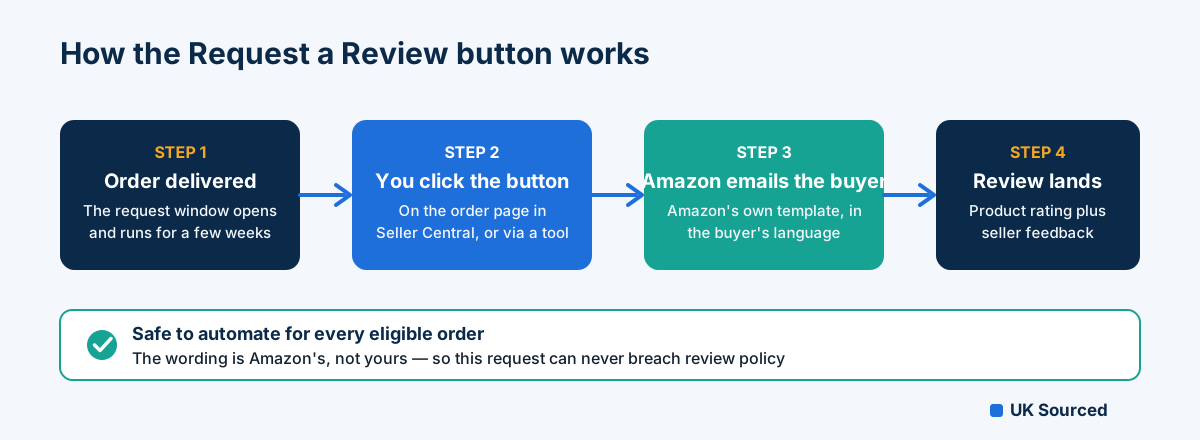 One click, Amazon's wording, zero rule-breaking surface. Automate it and forget it.
Product inserts: legal, if you can resist being clever
The little card in the box. Inserts are allowed — Amazon has no problem with a card that thanks the buyer, points them to support, and invites an honest review.
What gets sellers suspended is the urge to optimise it:
- "Love it? Leave us 5 stars!" — banned. You've asked for a positive review.
- "Leave a review and claim your free gift" — banned. That's an incentive.
- "Happy? Review us. Problem? Email us first" — banned. That's gating in a trench coat.
The compliant version is almost disappointingly dull: thank them, invite an honest review, and offer a support route if something's wrong — as a separate courtesy, never as a bargain. Write every insert assuming Amazon will read it, because eventually it will. Customers photograph cards and report them, and Amazon runs its own test purchases.
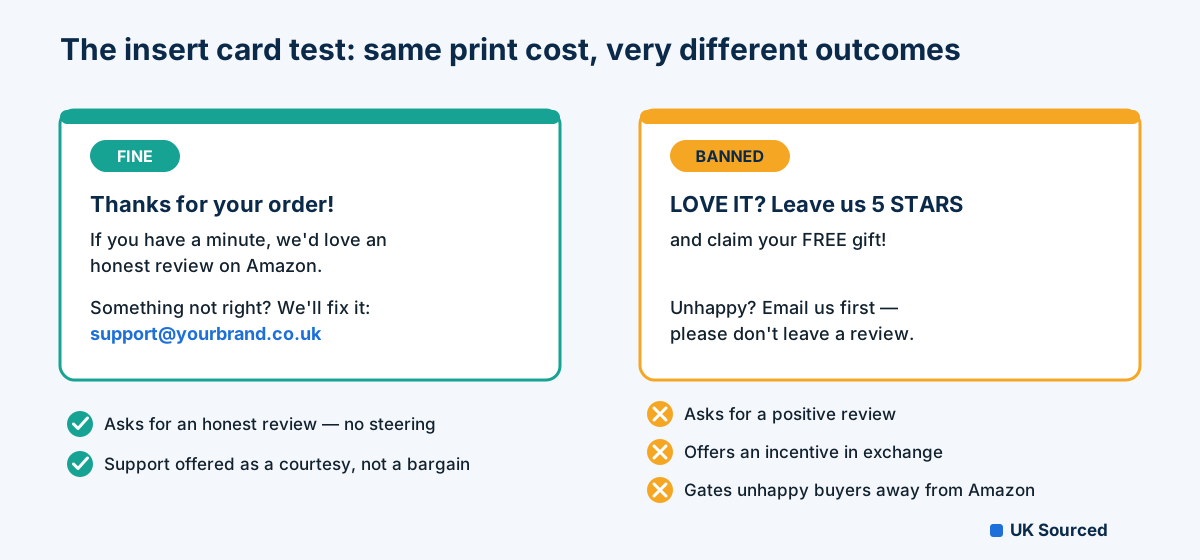 Two cards, same print cost. One builds reviews; the other builds a suspension case file.
Why buying reviews always ends badly
We'll be direct: buying reviews is the dumbest trade on Amazon. Look at what's on the table. You're renting a temporary bump, and you're staking the entire account — the brand, the stock, the cash flow — to get it.
Detection isn't a coin flip either. Amazon links reviewer accounts to each other, spots velocity spikes, buys from the same broker groups sellers do, and has sued brokers and obtained their client lists. It doesn't need to catch you this month. Purges happen retroactively; sellers get suspended a year after the campaign, long after the boost faded. We've watched a seller lose a five-figure-a-month account over a couple of hundred pounds' worth of fake reviews. The maths never works.
Even in the fantasy where you're never caught, you've bought a different problem: fake five-stars raise expectations a mediocre product can't meet, and disappointed real buyers correct the record with real one-stars. You paid to make your own customers angrier.
Vine: the one legitimate fast lane
Sometimes you genuinely need reviews quickly — a new launch, or a listing stuck under ten reviews and invisible because of it. Vine is Amazon's own answer. You give units free to an invited pool of experienced reviewers, and they leave labelled, honest reviews. Enrolment is tiered per parent ASIN: free for one or two units, a mid tier for up to ten, and a top tier of roughly $200 for up to thirty.
The word doing the heavy lifting there is "honest". Vine reviewers aren't grateful; they're critical. Put a strong product in and you come out with credibility money can't buy. Put a weak one in and it gets publicly filleted, on your own listing, in permanent ink. Whether the fee pays off for your product is a real decision — we've broken it down properly in is Amazon Vine worth it.
The unglamorous engine underneath it all
One last thing, because it's the part everyone skips. Review count is downstream of two things: order volume, and a product that doesn't irritate people. The button, the insert and Vine all raise your ask-rate — none of them changes what buyers actually think.
So read your one-stars like a free consultancy report. If the same complaint keeps appearing — sizing runs small, instructions unclear, arrived scuffed — fix that, and you've changed the ratio of every future review the machine collects. Nothing on this page outperforms a product people are quietly pleased with.
Get it all working together — button automated, insert compliant, Vine on launches, root causes fixed — and reviews stop being a source of dread. They just accumulate.
If you'd rather someone set that machine up and mind it for you, it's part of what we do all day. Drop us a line at enquiries@uksourcedltd.com.