What running Amazon in both the UK and the US has taught us
Seven hard-won lessons from running Amazon accounts in both the UK and the US — on growth, stock, advertising, seasons, compliance and who's already selling.
We run Amazon accounts on both sides of the Atlantic: for UK brands selling into America, for American brands selling here, and for our own products, which we sell on Amazon.co.uk and Amazon.com ourselves.
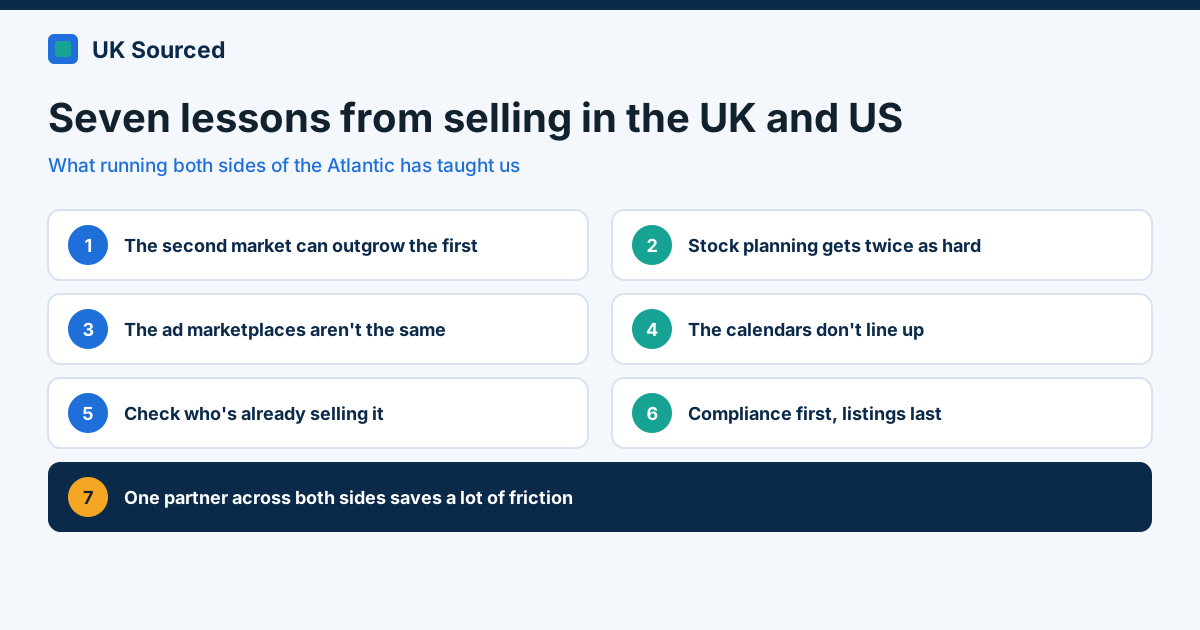
After a few years of that, some lessons have come up again and again. Some we learned cheaply. A couple cost us. Here are the seven we'd pass on to any brand thinking about selling in both markets.
1. The second market can outgrow the first
Brands tend to treat the second country as a side project. Sometimes it's the main event. We built one UK brand's US channel from a single sale to bigger than its UK business within a year, and it kept growing after that.
The flip side: it only happens when the second market gets real attention, with its own listings, keywords and advertising. Copy-and-paste gets copy-and-paste results.
2. Stock planning gets twice as hard across an ocean
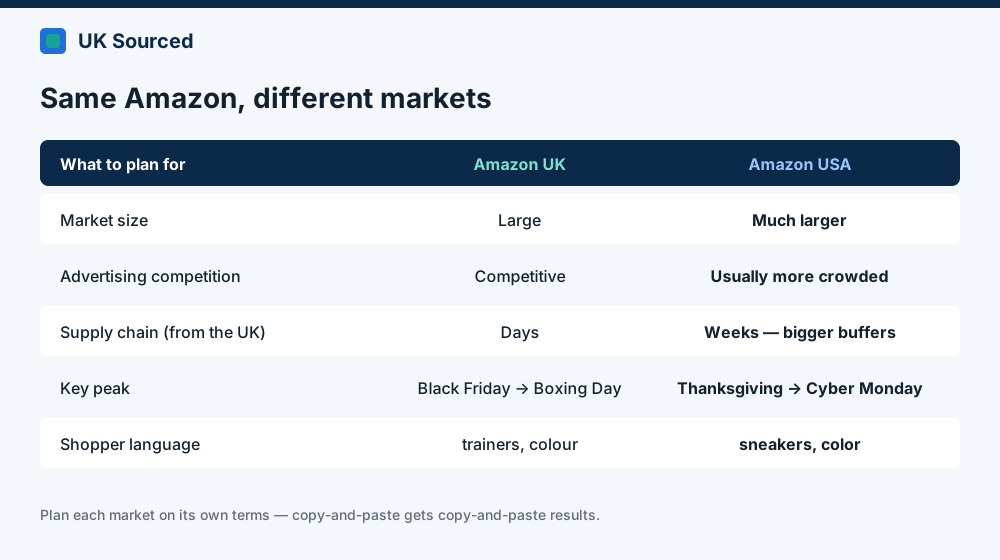
At home, a stock-out costs you a few days. Across the Atlantic, with sea freight, customs and inbound processing, a stock-out can cost you a month — and it takes your search ranking with it.
We've had a US bestseller run out for a whole month. We paused the ads rather than pay to send shoppers to an empty listing, and the month came in down on the year before. The lesson: hold bigger buffers in the far market and reorder earlier than feels necessary.
3. The two ad marketplaces aren't the same
The US is a bigger market, but it's usually more crowded too, and clicks in competitive categories are rarely cheap. Don't take your UK bids and targets across unchanged. Start each market with its own research, its own budget and its own idea of a healthy ACOS — and be ready to turn spend down when stock is tight.
4. The calendars don't line up
The big dates differ. America has Thanksgiving, then Black Friday and Cyber Monday as a single run. The UK has Black Friday too, but also Boxing Day, and its own gifting rhythms. Prime Day and Amazon's autumn deal events usually hit both markets around the same time. Plan stock for each market's peak separately, working back from the freight time, not just the selling date.
5. Check who's already selling your product over there
Before launching in a new country, look at who's already selling your product there. Sometimes it's a hijacker or a reseller you'll want to deal with. Sometimes it's a long-standing distributor that has been quietly building your brand for years — a relationship worth protecting, not competing with.
We've seen both. The fix is the same: find out before you launch, not after your first listing goes live.
6. Compliance first, freight second, listings third
The order matters. We've seen brands write beautiful listings and book freight, only to find the product needs extra US registrations or UK VAT from the first sale. Work out whether the product can legally be sold first. Then work out how to get it there. Then write the listing.
7. One partner across both sides saves a lot of friction
Running two marketplaces through two different teams in two time zones means double the meetings, double the handovers and things falling between the gaps. A single partner who runs both keeps the stock plan, the pricing and the advertising joined up.
The honest summary
Selling in both the UK and the US is more work than selling in one. But for a lot of brands it's also the biggest growth lever left. Most of the pain comes from treating the second market as an afterthought. Treat it as a market in its own right and it usually pays you back.
We're a UK-based Amazon agency that runs accounts in both countries, and we trade our own products on both marketplaces too. If you're weighing up the move in either direction, drop us a line at enquiries@uksourcedltd.com — we'll tell you honestly what we think.